Airline Network Planning and Hub Connectivity Optimization
Research Problem
Airline networks and airport hubs compete to attract connecting passengers traveling between cities worldwide. Airports such as Singapore, Dubai, Doha, Amsterdam, and Hong Kong compete intensely to serve as global connecting hubs.
However, airport capacity constraints and growing competition make network planning increasingly complex. Airlines and airports must determine:
- Which routes to operate
- How frequently flights should operate
- How to position themselves relative to competing hubs
Understanding passenger choices and anticipating competitor strategies are therefore essential for effective network development.
Contributions
Our research develops integrated models combining econometrics, optimization, and game theory to support strategic route network planning.
Key contributions include:
- Econometric models that explain passenger route choices based on factors such as connection times, flight frequency, travel distance, and socio-economic variables
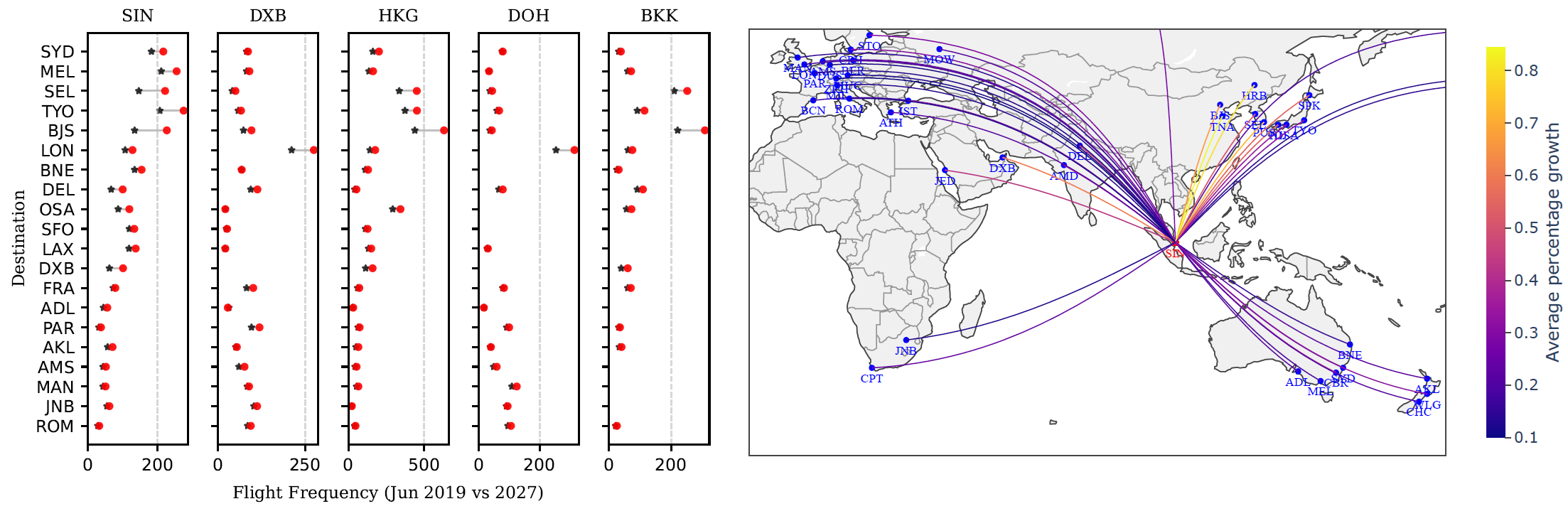
- Optimization models that determine the optimal growth in flight frequencies to maximize passenger capture
- Scenario-based forecasting using global population and GDP projections
- Game-theoretic models that capture competition between major hub airports
These methods help airports and airlines evaluate long-term network strategies in an increasingly competitive global market.
Selected Publications
- Hub Competition and Demand Modeling in Long-Haul Aviation Markets: A Forward-Looking Scenario-Based Game-Theoretical Approach
Li, M., Birolini, S., & Ribeiro, N. A. (2025). Available at SSRN.
Research Funding
- Civil Aviation Authority of Singapore
Airfield Management and Economics
Total Award: SGD 520,145