Airport Slot Allocation Optimization
Research Problem
Airport slots determine when airlines are allowed to take off and land at highly congested airports. At coordinated airports, demand for slots often exceeds available capacity, making slot allocation a complex and highly regulated process governed by the Worldwide Airport Slot Guidelines (WASG).
Slot coordinators must evaluate thousands of airline requests while balancing fairness, historic rights, operational constraints, and passenger connectivity considerations. Today, this process is still largely manual and rule-based, limiting the ability to explore alternative allocations or optimize system-wide outcomes.
Contributions
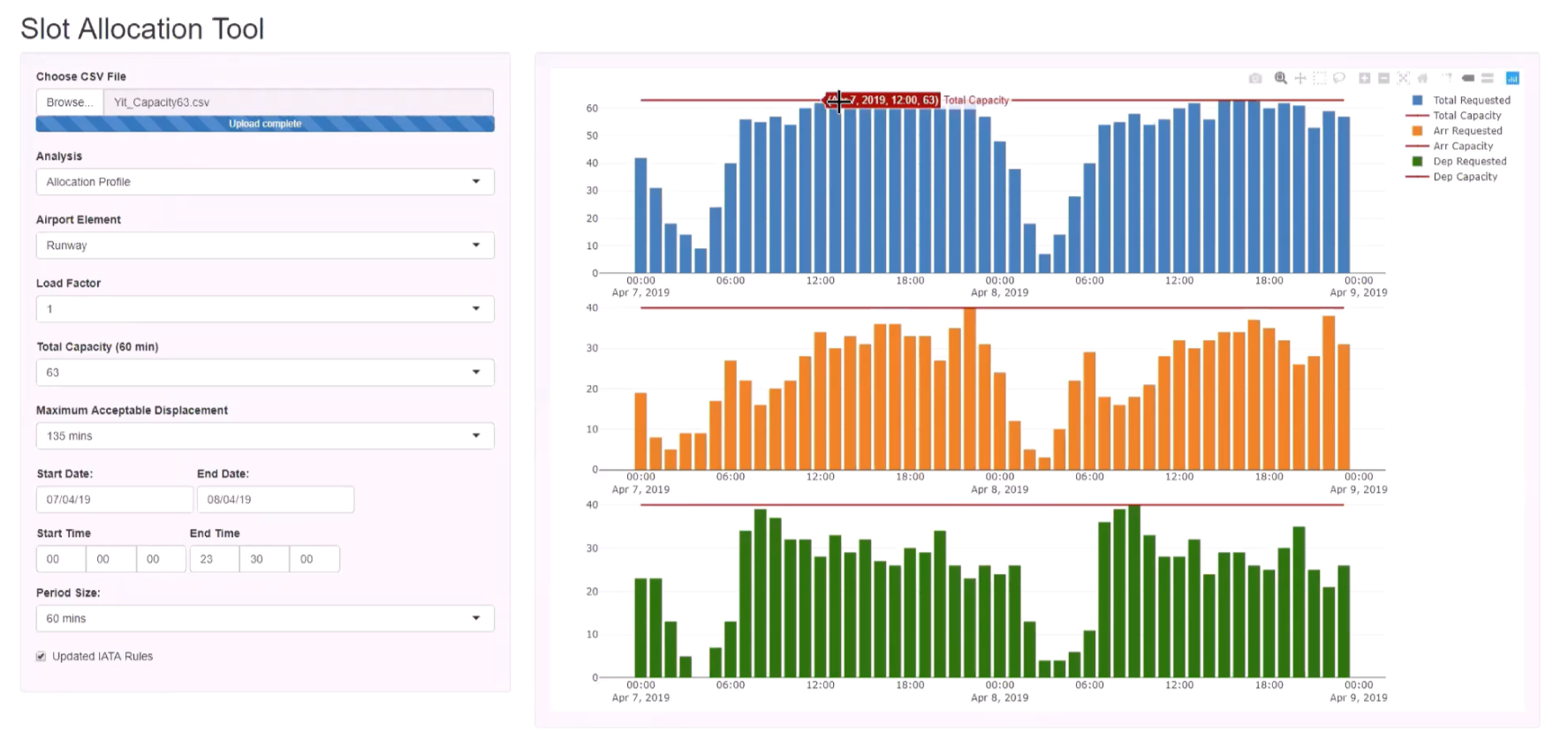
Our research develops advanced optimization and data-driven approaches to support slot coordinators in allocating airport slots more efficiently.
Key contributions include:
- Optimization models that allocate slots while complying with WASG regulatory constraints
- Large-scale neighborhood search algorithms capable of solving realistic airport instances
- Passenger-centric slot allocation approaches that preserve important passenger connections
- Data-driven models that identify critical connecting flows using historical flight and passenger data
- Empirical analysis of airline reactions to slot displacement
These methods help improve airport connectivity, airline schedules, and passenger travel times.
Selected Publications
- An Optimization Approach for Airport Slot Allocation under IATA Guidelines
Ribeiro, N. A., Jacquillat, A., Antunes, A. P., Odoni, A. R., & Pita, J. P. (2018). Transportation Research Part B: Methodological. - A Large-Scale Neighborhood Search Approach to Airport Slot Allocation
Ribeiro, N. A., Jacquillat, A., & Antunes, A. P. (2019). Transportation Science. - Improving Slot Allocation at Level 3 Airports
Ribeiro, N. A., & Antunes, A. P. (2019). Transportation Research Part A. - Towards a Decision-Support Tool for Airport Slot Allocation: Application to São Paulo Guarulhos
Jorge, D., Ribeiro, N. A., & Antunes, A. P. (2021). Journal of Air Transport Management. - Passenger-Centric Slot Allocation at Schedule-Coordinated Airports
Birolini, S., Jacquillat, A., Schmedeman, P., & Ribeiro, N. A. (2023). Transportation Science. - How Do Airlines React to Slot Displacements? Evidence from a Major Airport
Jorge, D., Ribeiro, N. A., & Antunes, A. P. (2022). Journal of Air Transport Management.
Research Funding
European Regional Development Funds
Airport Slot Allocation Process: Advancing Current Practices and Guidelines (2018–2021)Civil Aviation Authority of Singapore
Airfield Management and Economics (2019-2021) Total Award: SGD 520,145National Natural Science Foundation of China
Optimization Techniques for Collaborative and Integrated Slot Allocation for a Network of Airports (2025–2029)
Total Award: USD 383,943